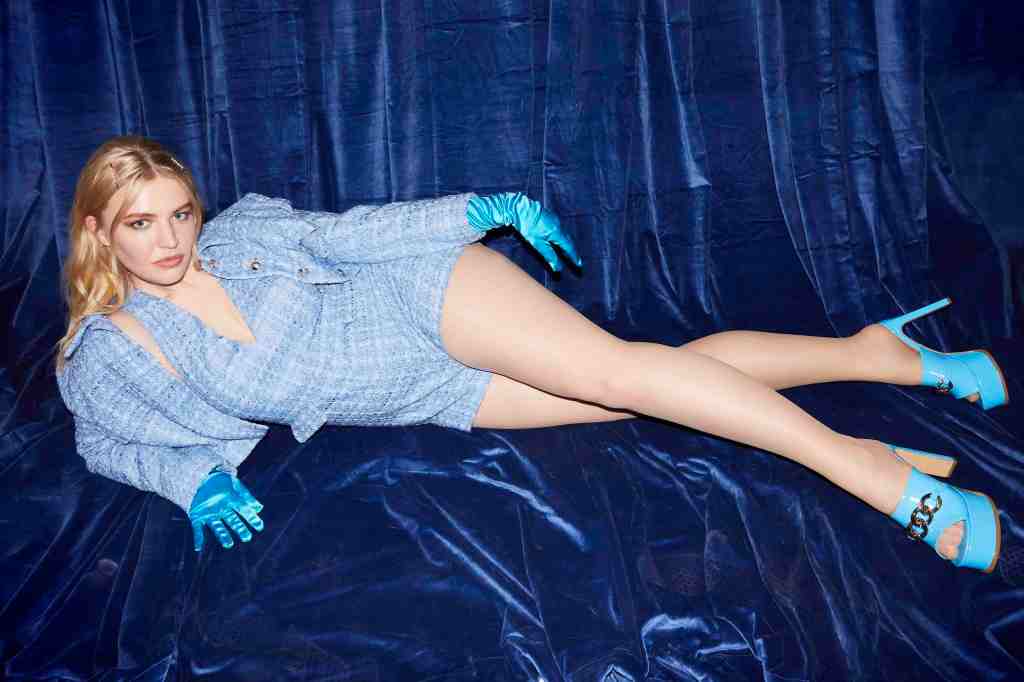
Rebecca Lucy Taylor is feeling a little frazzled. “I’m so sorry,” says the artist better known as Self Esteem, who missed our first appointment earlier this morning, and has now appeared on Zoom, unwrapping a towel from around her soaking wet head. “How are you? I look like shit!” she laughs, as she catches herself onscreen. “I’m behind on everything, and I’ve got a car coming for me at three, so I need to do my hair in front of you.”
Apologies, Weekend assures her, aren’t necessary, and if Taylor is slightly at sixes and sevens, that’s hardly surprising: as we speak, it’s a year, almost to the day, since the release of I Do This All the Time – the breakthrough single that announced Self Esteem as one of the most exciting and talked-about pop stars in Britain, and ushered in 12 months of frantic activity, during which her feet have barely touched the ground.
“I’ve not had a day off since,” she says in her earthy Rotherham accent. “It’s obviously amazing, and what I’ve always wanted. But the adjustment is still happening and… I think it’s hard to be an adult anyway, and I’m not a very orderly person. My nails are shit, my hair’s shit, I keep having to buy socks and pants ‘cos I haven’t had time to wash, and things like that. I keep thinking, ‘how does Victoria Beckham do it?’ But I guess they have people to do it for them, don’t they? And therein lies the discrepancy, with music, because you can, quote unquote, “make it”, and still be pretty skint.”
While she might lack actual funds, Taylor has no shortage of critical acclaim in the bank: her second album under the Self Esteem banner, Prioritise Pleasure, was voted the best record of 2021 by both The Sunday Times and The Guardian, who also declared I Do This All the Time the year’s best single. She was also named Artist of the Year by BBC Music Introducing, won Attitude magazine’s Music Award, and was nominated for two Brits and two NME Awards.
She is, then, very much having A Moment. But a week before our chat, Taylor had also tweeted a tongue-in-cheek message asking where her medal was for “honouring everything I said yes to when I was less burnt out”. Is there a certain irony, wonders Weekend, in an album called Prioritise Pleasure – a musical manifesto of self-empowerment on which Taylor renounces her former life as a timid people-pleaser – resulting in her working harder, and having to please more people, than ever?
“Yeah, but work is pleasure to me,” she insists. “It’s my reason for existing, and I love being this busy after 15 years in an industry going, ‘Hello, I’m clever, look at me, give me opportunities…’ I’ve just got to be better at doing it. It’s like, you can’t be working class and turn shit down. That’s something I really struggle with.”
Most of those 15 years in the industry were spent as one half of cult Sheffield folk duo Slow Club, alongside fellow vocalist/multi-instrumentalist Charles Watson. They enjoyed minor success, and supported the likes of Mumford and Sons and Florence + The Machine, but Taylor felt confined, both musically and personally, and the relentless touring wore her down.
In 2017, she re-emerged as Self Esteem – a radical reinvention of her entire brand that took in not just music but theatre, visual art (she directs her own videos) and social media. As a label, Self Esteem would also turn out to have a certain aspirational quality. “Though I didn’t mean that at the time,” she stresses. “I just thought it was a cool band name. I didn’t have any idea that I didn’t have any self-esteem, or that self-esteem might change my life and become a weirdly self-fulfilling thing. That’s why,” she adds, “I’m going to call my next album Loads and Loads of Money…”
It’s not just becoming a brilliant pop star that’s helped her self-esteem, though: she’s also gone down the more conventional therapy route. “That’s something I’m very committed to,” she says. “I’m not, like, fixed or changed. But there’s a natural amount of self-worth that I’ve now got. Being in a band for 10 years with a load of guys, you get very good at shape-shifting – for survival, more than anything. Not from my band mates, but from the industry as a whole. I was in the back of a van at 19, and only now do I see how fraught with danger that is, and how much of my behaviour was centred around either staying safe, or making sure I wasn’t being any trouble. I think a lot of women have felt that. And the point of my work, really… my dream is that women get to wake up and not have to fucking think about everything, in the way that men don’t.”
On Prioritise Pleasure, themes of self-care and self-actualisation run alongside stories of self-sabotage and millennial anxiety: I Do This All the Time, a deadpan spoken word memo-to-self punctuated by huge gospel choruses, reads like a sardonic update of Baz Luhrmann’s Everybody’s Free to Wear Sunscreen, in which Taylor contrasts her own advice – ‘Don’t send those long paragraph texts, stop it, don’t’ – with that of her former management: ‘All you need to do, darling, is fit in that little dress of yours… If you weren’t doing this, you’d be working in McDonald’s, so try and cheer up’. On the clamorous title track, meanwhile, she pledges to stop trying to please people who ‘liked the idea of me, in theory’. “Being a woman has sort of been a disadvantage for me my whole life,” she says. “And the album is just trying to illuminate that.”
The album’s sound – mixing tribal percussion (she is a fierce drummer) with huge gospel choruses and shards of jagged electronica – are the result of a collaboration with producer Johan Karlberg. “Sonically, it’s got to be big and dramatic and powerful,” she says. “So far, I’m renouncing any middle ground and any middle range notation. The Lion King is a big influence!”
The title, she adds, is “not as sexy as it sounds”: for her, prioritising pleasure could equally mean just staying in and not going somewhere she doesn’t want to go. And yet, it is also a sexual record, and deliberately so: having been a victim of sexual assault, Taylor is determined not to let it define her experience of sex. On I’m Fine, she sings of living ‘as proudly and as sexually as I like to be,’ adding: ‘You took that from me and you used it. But I’ll never lose it.’
“One in three women have been sexually assaulted – that’s unifying, and eternal,” she says. “And when something like that happens, you have a choice. For me, it felt like I needed to live smaller in order to be safe. And then I was like, ‘no, fuck that, that’s not fair’. That’s an injustice that’s boiling my blood every day. And if I can do anything about that with my art, then it’s worth it. Because what are women meant to do – just never leave the village?”
There is also a defiant subversion in her use of sexual imagery, like the high-cut leotard on the album’s cover, or the video for the single How Can I Help You?, in which she delivers a lesson on toxic masculinity while drumming in her bra.
But it’s not just that: after years of striking meek indie poses with Slow Club, Taylor is also enjoying indulging her confident “West End Wendy”, especially during her camply glamorous, sharply choreographed live shows. She is also, both in person and on stage, very funny – a scarce commodity among modern pop stars. “I’m a performer,” she says. “And one of the biggest turnarounds for me has been realising I need that, and that there’s no shame in accommodating my need to create.”
“The way women are supposed to have a shelf life… I just refuse that as a concept”
The daughter of a secretary mum and steelworker dad who grew up in a Christian household in Rotherham, the young Rebecca Taylor was a promising cricketer, until music turned her head (“though it’s not that hard to be a promising under-16 ladies cricketer in South Yorkshire,” she notes drily). Part of her, she admits, still thinks that performing is “for southerners and people with rich parents”, while shyness has previously kept her inner diva in check. “I get very intimidated by social stuff,” she admits. “But writing, performing – singing about my feelings and dancing and doing all this shit, that’s where I feel safe.”
Taylor’s recent Attitude award was given in recognition of her work as a queer musician (she came out as bisexual in 2013) – though she’s not fully convinced of her qualifications as an LGBTQI+ role model. “I don’t think my sexuality is very interesting,” she shrugs. “It’s cool if it helps anyone, but my bisexuality is just a fucking ball-ache, to be honest. I’m very fucking fine with my sexuality, I don’t give a shit, I refuse to live secretly, or with any shame. I guess that’s inspiring, if you need it to be. Not that any young people listen to me,” she adds, with a laugh.
There was a time, Taylor has admitted, when she felt compelled to lie about her age: now, she thinks it’s brilliant and hilarious for a 35-year-old woman to be nominated for Breakthrough Act at The Brits. “The way that women are supposed to have a shelf life, or whatever – I just refuse that as a concept. Who knows, maybe I’d be making more money if I said I was 29? But I wouldn’t sleep at night, because it’s pathetic.”
In the end, she lost out to Little Simz at The Brits, but it was okay, she says, because she met Doctor Who. “I was feeling a little deflated, and then Jodie Whittaker came up to me and said, ‘god I love your album’. And I was like, ‘oh my god’.”
Recently, Taylor has also been collaborating with another iconic Jodie, providing the score for Suzie Miller’s West End play Prima Facie, starring Killing Eve’s Jodie Comer as a lawyer who suffers a sexual assault. It’s been “an amazing experience”, she says. And there is surely no hotter ticket in 2022 than Jodie Comer and Self Esteem…? “Two gay icons, for sure,” she laughs.
This weekend, Taylor will cap off an extraordinary – if exhausting – year with what promises to be a triumphant appearance at the Glastonbury Festival. Is she excited? “Oh god yeah,” she says. “I’ve played the (BBC) Introducing stages and things, but I’ve never had a proper slot, so it feels like a real milestone.
“The basis of my career has been me looking at other people and going, ‘why not me?’ and being wound up about how impossible it is to get heard. It used to break my heart, that I wasn’t there [at Glastonbury] or a part of it. It’s not a case of ‘oh I’m so validated now you’ve offered me a slot’. It’s more that it just feels like, with everything in my life right now, I’m finally in situations that match my work ethic and my ambition.”
This article first appeared – with considerably less swearing – in Waitrose Weekend on 23 June, 2022
 Interesting Media