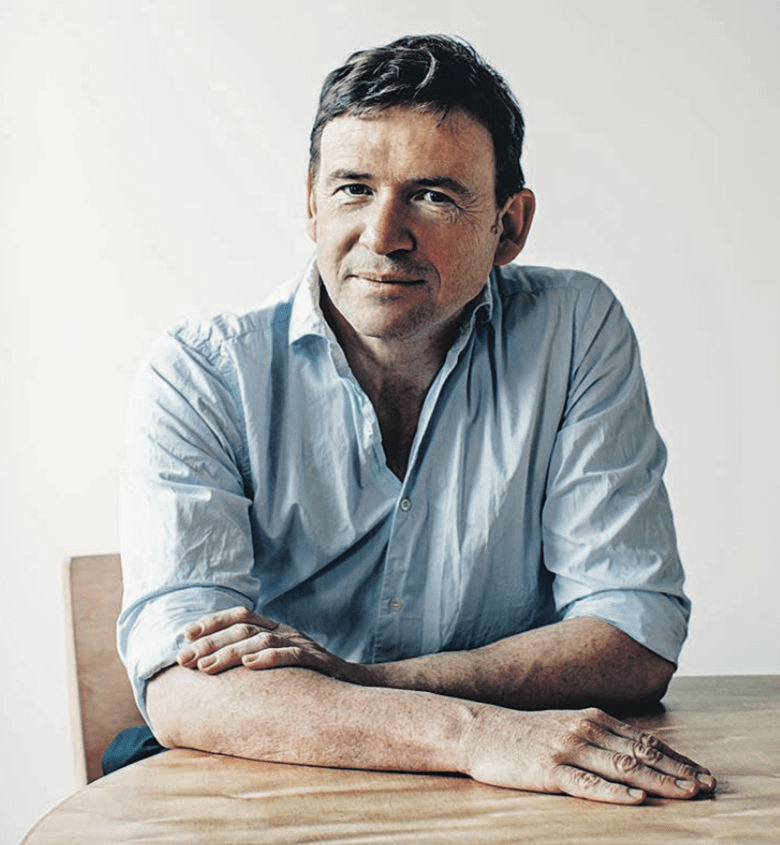
The year is 2009. Gordon Brown is Prime Minister, Slumdog Millionaire sweeps the board at the Oscars, and Susan Boyle outsells Beyoncé and Taylor Swift to become the UK’s unlikely new queen of pop. In publishing, meanwhile, the year marks the arrival of two very different, but equally cherished, literary sensations: Hilary Mantel’s Booker Prize-winning historical masterpiece Wolf Hall, and One Day, a tender, funny love story from TV screenwriter turned up-and-coming novelist David Nicholls.
By the following year, the paperback version of One Day – with its distinctive bright orange cover – is as ubiquitous on Britain’s commuter trains and airport shuttle buses as the new iPhone, and already well on the way to its tally of more than five million sales.
Talking to Weekend a decade-and-a-half on, David can still remember the ‘eureka’ moment when he came up with the book’s Big Idea: to tell the story of two young people, Emma and Dexter, on the same date – 15 July, St Swithin’s Day – over the course of two decades.
“I’d said to my agent, ‘I want to do a big, 20-year love story’ – because I’d just turned 40, and I’d just become a father, and I thought: well that’s it – goodbye to youth,” he recalls. “But I was very intimidated at the idea of writing 20 whole years. Because what do you leave out? Fortunately, I’d just been working on [the 2008 BBC adaptation of] Tess of the D’Urbevilles, in which there’s a wonderful chapter in which Tess thinks of all the anniversaries you pass through without knowing. And I thought that was an amazing idea: to write about an ordinary day full of stuff that doesn’t reveal its significance until years later, and in which there are all sorts of things you don’t see, that will make the reader want to fill in the other 364 days.”
It was a format that came with its share of logistical challenges. “There were a lot of charts,” he smiles. “And you’ve got to play a certain trick, which is that the day has to be ordinary, but it can’t be too ordinary, otherwise it could be deathly. So you have to put in enough juicy stuff to keep the reader reading, without betraying the format.”
Keeping the reader onside turned out not to be a problem: In Emma and Dexter – she working class, northern and idealistic, he posh, southern and, on first impressions at least, shallow – David created a pair of star cross’d lovers to equal Romeo and Juliet, or Ross and Rachel.
Though, for a romantic comedy, they’re not actually in the same room – let alone the same bed – that often. “On most July 15ths, they don’t even see each other,” says David. “They’re only together for about 25% of the book. There’s a lot of trickery involved to make it feel like they’re together.”
One Day’s word-of-mouth success propelled its creator to the top of the bestseller lists – though David remained largely oblivious to that sea of orange paperbacks. “I don’t go on the Tube, I cycle everywhere,” he says (as we speak, there’s a racing bike propped up behind him in the study of his north London home). “But people used to tell me it was everywhere, which is an author’s dream, really. The way it took off was a great experience, but also quite… disconcerting, in some ways,” he admits. “I found it very hard to carry on writing, because it took over my life for a couple of years. But I would never complain about that, because I’m very lucky.”
At least some of those years were spent writing the screenplay for the 2011 film adaptation of One Day, starring Anne Hathaway and Jim Sturgess. The Los Angeles Times called it a “heartbreaking disappointment of a film”, and many fans of the book – your correspondent included – felt moved to agree. Were we unduly harsh?
“I think there’s a long, long history of much-loved books not being as loved on screen,” reasons David. “It’s a hard thing to pull off, because part of the thing that makes them loved is the very personal connection people have with the version they play in their head. And with this story, you have the particular challenge with the arithmetic of it, in that 20 years into a hundred minutes is five minutes a year. So it’s very hard to get the pacing right.”
Get ready to break out the bunting, then, because, 15 years on, One Day has finally got the screen treatment it deserves, courtesy of a new, 14-part Netflix series from Bafta-winning screenwriter Nicole Taylor (Three Girls) that will charm, seduce and rip your heart out in equal measure.
“I really love it,” grins David, who serves as an executive producer on the show (and wrote one episode). “I’ve been involved it, but I’ve also tried not to be too much of a backseat driver. I was worried about that to begin with,” he admits, “but it’s actually been incredibly harmonious, and I’m delighted with the finished version, which feels both faithful and – for reasons I can’t quite work out – different and fresh.”
The casting certainly helps on that score: Ambika Mod, who announced her arrival as a major talent in the BBC’s recent adaptation of Adam Kay’s This Is Going To Hurt, brings exactly the right mix of warmth and saltiness to Emma, while Leo Woodall – fresh from his equally star-making turn in HBO’s The White Lotus – defies you not to love Dex, warts and all. “We really lucked out,” agrees David. “They’re so great together – lovable, but also flawed. I can watch them forever.”
The beauty of being on a streaming service also means that each day gets the length of episode it needs (generally around the very snackable 30-minute mark). “You want people to consume the series in the same way they consume a book – so they say, ‘just one more chapter, or one more episode, before bed’,” says David. “That can be hard to do with love stories, or stories that are more domestic, and don’t have the big story beats of a thriller. But I think they’ve done it here.”
The book that did eventually follow One Day was Us, David’s heartbreaking (but still very funny) 2014 novel about Douglas, a man whose midlife crisis compels him to embark on an ill-fated tour of Europe with a wife and son who really don’t want him around any more. “It wasn’t quite a warning to myself, but I was aware of the potential I had to become very controlling – to always be walking ahead in airports, and never being able to really find the joy in things,” says David, who has two teenage children, Max and Romy, with his partner Hannah Weaver, a script editor.
“I was 44 when I wrote that novel, and now I’m finally Douglas’s age, and I think I’ve dodged most of that. But the potential is definitely there. There’s a tiny bit of me in Douglas. Because it is important to have a plan, and to pre-book things,” he laughs.
In 2019, David’s novel Sweet Sorrow – an achingly poignant tale of teenage love and longing – further cemented his status as one of the wisest, truest observers of the human condition in modern fiction. But while Us was longlisted for the Booker Prize, he ended up taking home the Specsavers Author of the Year award instead. Is this partly snobbery on behalf of the literary establishment, wonders Weekend: a sense that anyone who sells that many books (Wolf Hall, a blockbuster by Booker standards, has shifted around a fifth as many copies as One Day) must somehow be ‘middlebrow’?
“I don’t know if it’s a good idea for authors to think too much about where they come on the brow scale,” he reflects. “In terms of how I’m published and perceived, I have no complaints. I’m extremely lucky. But I try to write well, and I do think I’ve got better. I try to play with the form a little bit, and do new things.”
Does he find the process of grinding out a book painful? “I’m wary of calling it painful, because I know it’s a huge privilege, to be able to do it for a living,” he says. “I do grind my teeth, and I do lie awake a lot, fretting and worrying. But I think whatever job I did, I’d lose sleep and worry.”
Growing up in Eastleigh, Hampshire – where his mum worked for the council and his dad was a maintenance engineer at the local Mr Kipling cake factory – David was a “bookish” middle child, addicted to reading and watching TV. “I was very bad at sports,” he says. “Even now, if someone throws a ball at me, or the keys from an upstairs window, I panic. I was a bit pretentious, and quite awkward. Adrian Mole is probably the strongest sense of identification I’ve ever had with a character.”
After studying drama and English at Bristol University, he won a scholarship to train as an actor at the American Musical and Dramatic Academy in New York. But one of the kids from Fame, it turned out, he was not. “It was this crazy school where everyone was dancing and singing and clapping away, and I couldn’t do any of it,” he recalls. “I was completely lost there. I wanted to be in Richard II, or play Rosencrantz or Guildenstern – not even Hamlet, just one of those nice second or third-tier speaking roles.”
He did eventually make it to the National Theatre, but as more of a spear-carrier than a supporting lead. “I just wasn’t a very good actor,” he shrugs. “It was the wrong career for me.”
Pivoting instead to writing, he got his big break scripting episodes of ITV’s Cold Feet, and remains an in-demand screenwriter, earning a Bafta and a Primetime Emmy for his 2018 adaptation of Edward St Aubyn’s Patrick Melrose, starring Benedict Cumberbatch, and turning Us into a fine 2020 miniseries, with Tom Hollander as Douglas.
As for the story that made his name… David has previously said he’d probably be “too self-conscious” to write One Day now. “It feels like a younger man’s book, I guess,” he explains. “In that it’s full of passion and love of friendship, and all those things. And for the last 17 years, I’ve been more concerned with family, and being a parent.
“Also, I think it’s more… not melodramatic, but it’s full of big emotions, and I’m probably a bit more constrained about those things. I’ve got a new book coming out [You Are Here, published in April], which is written in much more of a minor key. I’m very proud of One Day, but I think I’d be less likely to take those risks with its tone now.”
Billed as ‘a novel of first encounters, second chances and finding the way home’, You Are Here tells the story of Marnie and Michael, two lost souls who find themselves thrown together on a coast-to-coast walk across England. “It’s about loneliness, really,” says David. “It’s much more of a conversation piece than One Day. It’s also about walking and hiking, which isn’t something I’d have written about when I was 40, either.” (Today, he’s a keen walker who, like Marnie and Michael, can often be found traversing the hills and fells of Cumbria and Yorkshire.)
Minor key or not, You Are Here is still “a sort of love story”, and David admits he can’t envisage ever writing a book with no romantic entanglements at all. “I’ve never written anything because I’ve thought, ‘oh, this is what people want’,” he says. “After One Day, I did write 40,000 words of a novel with no romantic love in it, and it was loveless in every respect. It was quite a mean and hostile book, and I’ve never regretted abandoning it, because it was perverse, and it didn’t come easily. The relationships we have in our life – be they romantic or friendships – are often their defining feature. It’s a rich subject matter, and it doesn’t feel to me as if I’m running out of material yet.”

One Day is on Netflix now
This interview was originally published in Waitrose Weekend on 8 February, 2024
 Interesting Media