
Why is UNIT’s Sergeant Benton celebrating 50 years of active service with a tour round a workshop in Nottingham? DWM tagged along to find out.
In 1973, John Levene was filming Doctor Who in a Welsh coal mine when he spotted a young boy watching nervously from the sidelines.
“I went over to him and said, ‘You look a bit scared,’” the actor recalls. “He said, “Jon Pertwee is my hero, and I would like to say hello to him”. So I took him up to Jon.
“I’m a feeling person,” John interrupts his own story to assure DWM at this point. “I would do anything for anyone else before myself. I don’t do it for effect. I do it because I can’t help it.
“Anyway, 43 years later, this boy, who had now grown into a man, came up to me at a signing and gave me this beautiful miner’s lamp, made of pure brass. He remembered that day, and he’d come all the way to Birmingham to give me this lamp.”
Such is the enduring power of Doctor Who. This month marks 50 years since John made his debut as Corporal (later Sergeant) Benton in 1968’s The Invasion – the story that introduced ET-fighting military black ops outfit UNIT to the world. And to celebrate this milestone, he’s come to spend the day looking around a factory in Nottingham. Like you do.
This isn’t just any factory, though. This is the home of Warlord Games, which since 2017 has been producing a Doctor Who tabletop game called Exterminate: Into the Vortex, accompanied by an ever-expanding army of beautifully detailed pewter miniatures. And now it’s John’s turn to be shrunk down to size – 28mm, to be precise – as Sergeant Benton prepares to hit the shelves as part of a new UNIT pack.
Despite having got up at stupid o’clock and skipped breakfast to catch the train from his home in Salisbury, John bustles into Warlord’s HQ, housed in the Grade II listed former Raleigh Cycle Company head office, like a one-man whirlwind, launching into his life story before he’s even taken his coat off.
“I was born in 1941, Christmas Eve, five minutes to midnight. I was born breach – feet first – so I drowned in my mother’s water, and the umbilical chord choked me to death, and I was dead for a minute and 48 seconds, and the fact that I’m still alive, at 76 years old, having been born dead, and had some major illnesses… I lost my lung to TB, I had peritonitis when I was in Hollywood, with one hour to live…”
And so it goes. In the minutes that follow, he regales a small audience made up of DWM, Warlord staff and a handful of curious browsers in the factory shop with a stream-of consciousness oratory that moves from his years in America (“I nearly made it – I came close to making five million dollars for one part”) via the Salisbury novichok poisonings to the time he was accosted in the street by his then-neighbour Anthony Hopkins (“He said, ‘I saw your show last night – what a great face actor you are’”).
He also peppers his speech with a volley of rapid-fire gags – spoils from his other career as a stand-up comedian, cruise ship cabaret act and compere. (In 2002, under the name John Anthony Blake, he even hosted the Emmy Awards. It was the Pacific Southwest Emmy Awards, but still.)
“I never stop talking and I don’t breathe,” explains John. “Living alone [he lost his beloved wife Jennifer a few years ago], you end up not talking to anyone. Loneliness is a killer. So when I do see people, I can’t bloody stop.”
He produces a suitcase, like a travelling salesman, from which he extracts some glossy Benton artwork prints that will be available at a signing session planned for later in the day. ‘Who wouldn’t want to own one of those?” he beams, adding that he’ll sign it “with my £12 specially made ink biro.”
He’s pleased as punch at the thought of meeting mini-Benton today. “The whole idea of having a toy made of you…” he marvels. “When I was six-years-old, we were poverty stricken and starving, but I had a little toy of Roy Rogers, and I remember thinking: wouldn’t it be amazing to be an actor and have a toy made of you? And would you believe it, it happened to me. I’m stunned and amazed.”
John has been stunned and amazed for half a century now. Of all the extended Doctor Who family, he is the one who gives the strongest impression of simply not being able to believe his luck. He loves Doctor Who so much, it has even brought about a religious conversion. But we’ll come to that.
Surprisingly, he has Kojak to thank for all this. In 1966, John Woods (as he was then) was working in a menswear shop in London when Telly Savalas came in, and suggested he had the right physique to play a soldier in a film he was making called The Dirty Dozen. John wasn’t successful, but it inspired him to sign up with an extras agency, and he worked solidly from day one – something he puts down to being 6’2” and having “a good face and a good head of hair – the camera liked me.”
In 1967, he made his first (uncredited) Doctor Who appearance as a Cyberman in Patrick Troughton adventure The Moonbase. Having played a Yeti in the following year’s The Web of Fear, he was all set to don his Cyber costume again for The Invasion. But when the actor hired to play Benton was fired, director Douglas Camfield promoted John to a speaking part – one which, as luck would have it, would resolve into a regular role when producers decided to exile Jon Pertwee’s Third Doctor to Earth.
Even now, John finds it hard to talk about “Dougie” without getting emotional. “How do you thank…” he says, his voice cracking. “How do you thank a bloke who doesn’t know you, who sees that you’ve got something, and gives you a part like Benton? The fact he had seen something in me…”
“And we know now he was right,” he adds. “Meaning, could anyone else have done Benton like me? I didn’t play him tough, and I’m not a macho man.”
This is something of an understatement: John is a highly sensitive individual, whose emotions run close to the surface. “Jon Pertwee said I had a butterfly soul,” he smiles. “I can be crushed. Roger Delgado was the same. We were so easily damaged. It’s interesting that I played a soldier. But then soldiers don’t kill all the time.”
John worshipped – still worships – the dashing Third Doctor. “If it hadn’t been for Jon Pertwee, I don’t suppose I’d be here today,” he reflects. “He was everything to me. My dad was a war hero, and he hated me. I don’t blame him for that – I did then, but I don’t now. But Jon was my father, and I was his son. I loved Jon.”
It’s time to start the factory tour: first call, the design studio. Ever the showman, John stops in the corridor outside to rehearse his opening line, before bursting in with a booming, “Okay, what are you people making in here?”
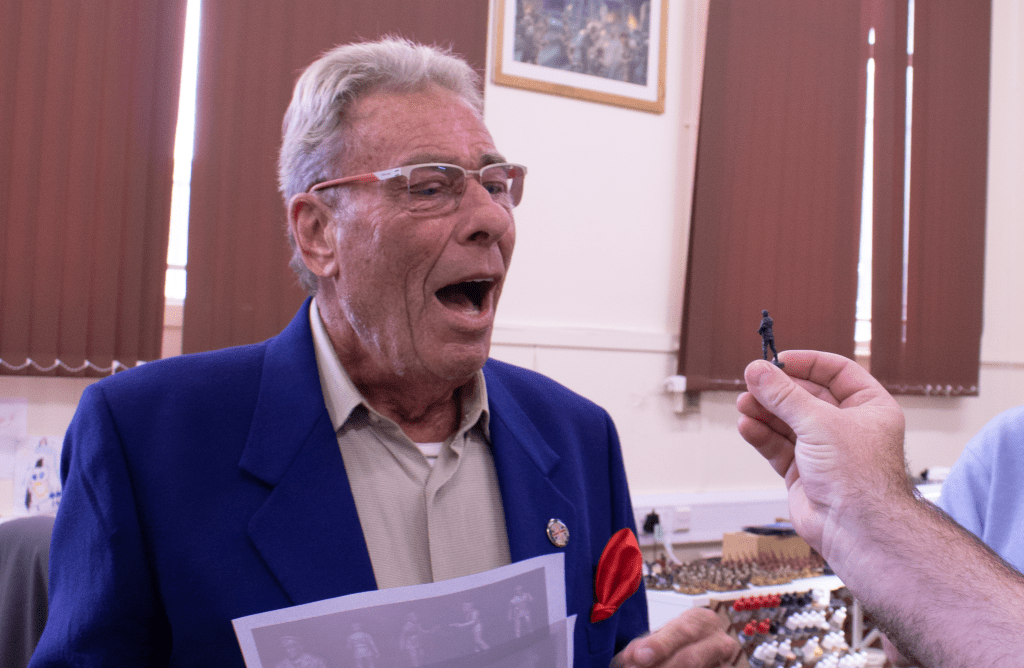
He works the room, charming everyone (“Let me say hello to the ladies, because ladies are nice”). Then studio head Paul Sawyer presents him with a plastic 3D print of the almost finished Benton figure, at which he appears a little overwhelmed. “I don’t know what to say. You do understand how this is weird? Seeing bits of yourself… To think kids are going to be playing with this…”
Browsing Warlord’s extensive range of Doctor Who figures – everything from Time Lords to Tetraps, the Movellans to Martha Jones – he couldn’t be more admiring of the team’s handiwork: “Look at that… I can’t believe the quality… Feel the weight… It’s the detail that’s blown me away… Look at the ribbing on the Brig’s pullover…”
As the tour continues through Warlord’s sprawl of outbuildings, John asks interested, detailed questions (“Who decides the poses? What do you do with the discarded packaging?”), every inch the minor royal on an official engagement.
“You won’t know me but it’s nice to see you,” he says, striding into one workshop with what can only be described as a confident humility.
This curious mix of vulnerability and self-belief manifests in other ways, too. John routinely dismisses his talents: “I’m not a real actor,” he tells DWM. “I was never going to be great. I got by with my humour, because I had nothing else.” At the same time, he’ll earnestly and unselfconsciously extol his personal virtues: “I love integrity, I have to say,” he has to say. “I have a very strong filter of integrity, which is most likely why I’ve not made any money. I’m a little too honest for this business.” He also insists that: “Vanity and ego are something I’ve never had to deal with. Apart from making sure you haven’t got spinach in your teeth.”
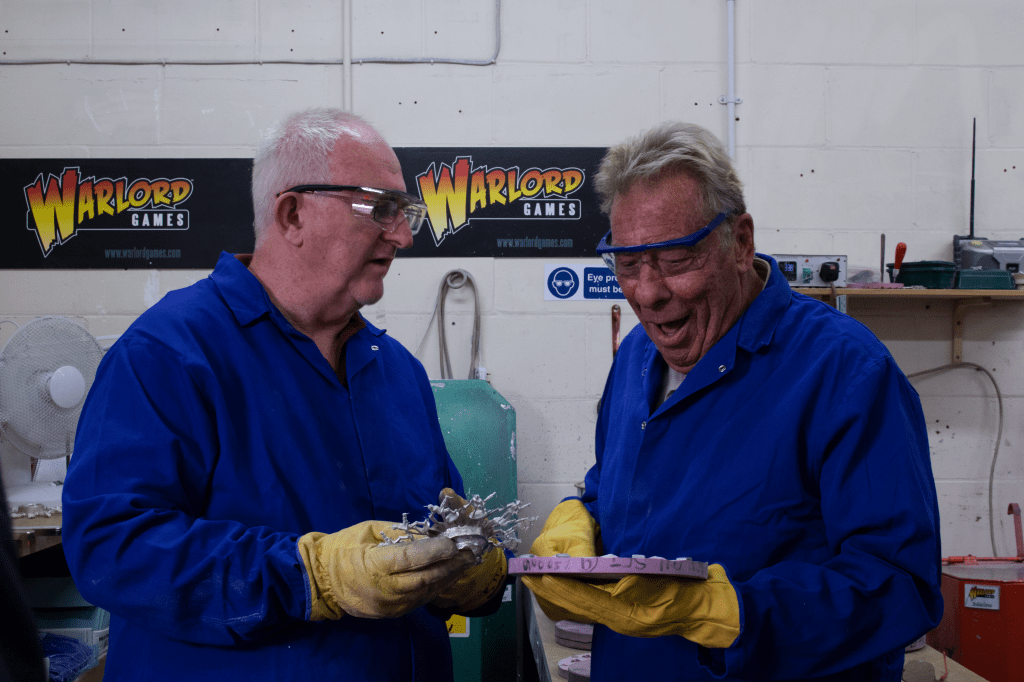
We move onto the casting room, where John is only too happy to slip into bright blue protective clothing to cast a figure of a Levene-vintage Cyberman. “I was perfectly cast in Doctor Who and now I’ve made the perfect cast!” he says, playing to the gallery.
It’s clear the red carpet treatment, and the whole experience, has given him a boost following a difficult period in his life. “This has knocked me out,” he says. “You could live your whole life and not get to do something like this. I’m actually stunned, and it’s quite nice to be stunned at my age.”
He’s so full of enthusiasm, in fact, that DWM finds itself becoming slightly anxious at the thought of the upcoming signing session. A factory on a Friday afternoon in Nottingham is hardly Comic Con – what if no-one turns up? We couldn’t bear to see that butterfly soul crushed.
As it turns out, there’s a steady trickle of fans approaching John’s table to get their photos inscribed by his £12 biro. Throughout the session, John – who by now has slipped into one of his old UNIT jackets – continues to talk a blue streak, with some of this morning’s jokes now coming round for a second time. He also tells a typically candid, and rather sad, story about his mother’s missing inheritance, as a result of which he is now living on a rather miserly pension.
Despite this, he constantly undercharges on the advertised price of a signed picture. “I really need the money, but I just can’t do it,” he laments, as another customer leaves with a bargain. Maybe he really is too honest for this business.
One fan, Mike, has travelled all the way from Wrexham to meet John. Another couple arrive complete with baby bump. “I’m making a Doctor Who fan,” the expectant mum tells John. They don’t know the sex yet, but John is insistent that “it’s a boy”. He can feel it in his water.
There’s an awkward moment when John tells a blushing teenage lad: “Don’t be shy all your life. It will kill you. And it just makes other people feel bad.” He also tells him to stop hiding behind his hair, and gently chides him over the strength of his handshake. “I was you, until I met Jon Pertwee,” he says. And at this point you understand what he’s trying to do. John genuinely wants to be the person, like Jon Pertwee was for him, who makes a difference to this young man’s life. But your heart goes out to the kid.
A 17-year-old girl called Tiger tells John she thinks Benton is “awesome”. Why? “Because he was loyal to the Doctor.” “I love that!” beams John, delighted. “Because I loved Jon.”
“This is so exciting,” grins Tiger, who has been a Doctor Who fan since the age of seven.
“I can see you’re excited,” says John. “I know what it feels like to meet your heroes.”
The encounter leaves him elated. “The energy this young lady’s shown,” he says. “That’s what our show has done. And that’s why I now believe in God.”
Well that’s… Wait, I’m sorry, what?
“There’s got to be a God, otherwise Doctor Who would not have flourished,” explains John. “It’s all down to good versus evil. God versus the Devil. And UNIT was on the side of God. You’ve really affected me,” he tells Tiger. That much is clear for all to see.
Before John heads to catch the Salisbury train, John Stallard – who co-founded Warlord with Paul Sawyer – presents him with the Sgt Benton stack card that will be used alongside his figure in the game. Not for the first time today, he looks genuinely astonished. “I must be the luckiest b*****d on Earth,” he declares. “Who else gets this?”
If that seems like a strong reaction to a playing card, then that’s John all over. He’s a big man, with a big heart and, as he’s the first to acknowledge, a thin skin. He doesn’t sugar-coat the dark times: “I’ve had a sad, brutal life, there’s no point denying it,” he says. “I was born dead, my father hated me, my school days were torture. I was beaten up, I was put down. I couldn’t take any more.”
And then, one day, he met the Doctor.
“The happiest time of my life was knowing I was going to be waking up in the morning, driving to the Doctor Who rehearsal room,” says John. “Knowing I was going to be picking Jon Pertwee up and driving his sports car, and picking Katy Manning [who played Jo Grant]. I’ve loved Katy from the minute we met. To walk into that rehearsal room – for me, as the man with the butterfly soul, to see Roger Delgado [The Master], laughing with Jon Pertwee…” He shakes his head.
It’s never stopped being a part of John’s life. He was the first Doctor Who star to appear in a spin-off video (1987’s Wartime). He still occasionally reprises Benton for Big Finish’s audio range. Even his 2012 album – a collection of standards including Catch the Wind, Lady in Red and If I Were a Carpenter – was released under the title The Ballads of Sergeant Benton.
For John, Doctor Who is a bit like that that brass miner’s lamp: a beacon that has guided him through some long, dark nights, and continues to light his way today. Over half a century, it’s a journey that has taken him from the surface of the moon to a factory in Nottingham, and he wouldn’t change it for the world.
“I can’t imagine what would have happened to me if I’d never been in Doctor Who,” he says. “The whole thing was magical. I mean, what bigger show is there? Oh my god, my joy and my pride at being a part of this. It’s never ending.”
TIME SLIP
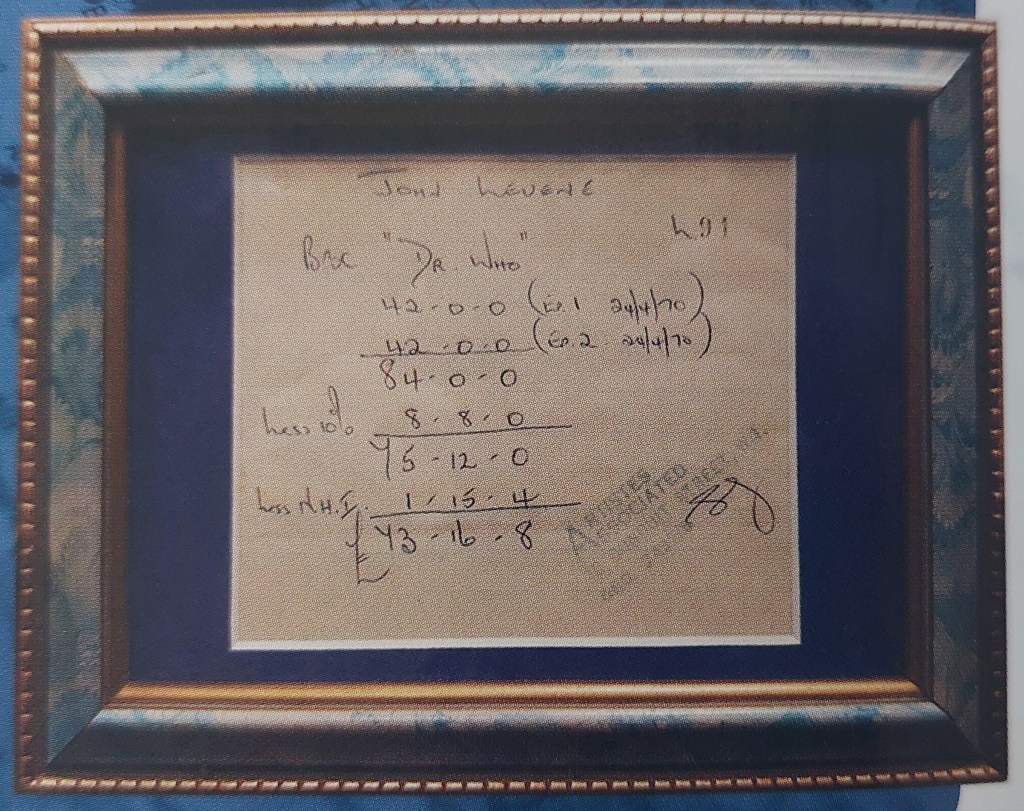
During his Nottingham trip, John unveiled a unique piece of Doctor Who history – an original payslip, received from his agent in 1970.
“For nearly 50 years these were lost,” he explains. “We thought we’d lost some in a fire in Los Angeles, and some others in a flood in my mum’s house. All gone. But bless me, a few of them turned up.
“This has to be one of the oldest and most personal Doctor Who artefacts in existence,” he says, revealing a framed receipt dated 24/4/70 – most likely for his work on Season 7’s The Ambassadors of Death.
The fee – in pre-decimal pounds, shilling and pence – is for £84 (two episodes at £42 per episode), minus agent’s 10%, less National Insurance, giving him a take home wage of £73/16/8d.
Not exactly a fortune, then. But you suspect that, for John Levene, simply being in Doctor Who was riches enough.
This article was published in issue 531 of Doctor Who Magazine, October 2018
 Interesting Media