This is an expanded version of the Season 18 Blu-ray review that first appeared in Doctor Who Magazine issue 536, April 2019
Of all the series in Doctor Who’s long and unexpected history, Season 18 stands as perhaps the most singular and distinctive. Fated to be the end of one thing and the start of another, it ended up being a bit of both, and a bit of neither. It is also glorious.
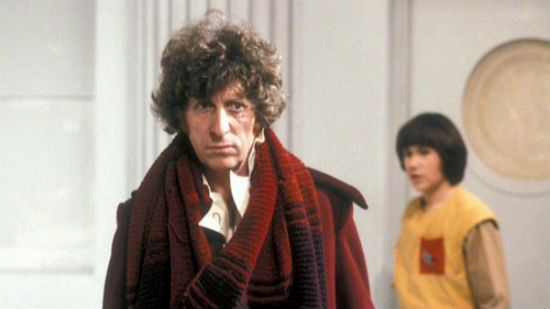
Partly, its sense of dislocation comes from the fact that, in our collective folk memory, Tom Baker belongs as much to the 1970s as The Fonz and Evel Knievel. So when John Nathan-Turner checked his watch, saw that it was now the 1980s and promptly set about dragging the show into the age of the BBC Micro – glitzy new neon titles, Fairlight synth theme and all – its outgoing star already looked like a man out of time. Even his raggedy costume had been replaced by a smart Sunday best version to stop him making the place look untidy.
In hindsight, it’s easy to mock Nathan-Turner, script editor Christopher H Bidmead and (lest we forget) exec producer Barry Letts’ desire to rid the show of the “undergraduate humour” of Douglas Adams, of all people. But it’s true there’s a Footlights revue quality to the previous run, not least in its frequently makeshift production; Season 18, by contrast, displays a new level of technical competence – flair, even. And how strange that it should be Bidmead, the computer journalist, and not Adams, the wide-eyed and curious polymath, whose series ended up being the most about ideas.
It’s also become fashionable to knock Bidemad’s insistence on stories being rooted in “hard” science. But wasn’t that at least 50% of the show’s original remit? Plus, if you can’t find inspiration and wonder – if you can’t find poetry – in the vast, strange, impossible realm of science, perhaps it’s time to ask if you’re cut out to write science fiction in the first place.
Okay, so The Leisure Hive’s preoccupation with tachyonics was never going to win the Star Wars generation back from the disco robots and figure-hugging spandex of Buck Rogers in the 25th Century over on ITV. But how many people, in 2019, are clamouring to see Twiki and co scrubbed up for Blu-ray, in the same way The Leisure Hive‘s Brighton beach scenes have been lovingly upscaled to HD? Sometimes you have to let history be the final judge.
Elsewhere, this is a run of stories that pops with invention and imagination, an approach that finds perhaps its most perfect expression in Warrior’s Gate, a giddily strange grab-bag of Jean Cocteau, Samuel Beckett, Chinese philosophy and “a short course in cytogenetics”, made in the style of an Adam and the Ants video. And where else in 1981 would you have found anything quite like The Keeper of Traken: a hard sci-fi Midsummer Night’s Dream with a monster based on Italian Futurist Umberto Boccioni’s sculpture Unique Forms of Continuity in Space? Certainly not on Buck Rogers. Then there’s Full Circle – full of clever little notions about evolution and hope, which somehow succeeds in making a country park in Buckinghamshire look like a lush, fertile alien swamp world.
Of the seven stories, only Meglos – a cheap and tatty story about a psychotic cactus – feels like a throwback to the previous regime. (State of Decay, of course, was literally a hangover from Doctor Who’s mid-70s gothic period and, pleasingly, is made with just as much conviction as Robert Holmes and Philip Hinchcliffe would have brought to it. It is also very, very funny.)
It’s no secret Tom Baker was unhappy, and ill, while making these stories, and he often cuts a gaunt, bloodless figure compared to the goofy ringmaster of just a year earlier. But even this adds to Season 18’s uniquely funereal atmosphere: as if the whole series is one long march toward the guns.
No surprise, then, that new Logopolis documentary Hanging on a Thread finds Tom in less Tiggerish form than usual, lamenting how much he “deplored” John Nathan-Turner’s “vulgarity” in everything from scripts to costumes. Elsewhere, Richard Latto’s terrific film roams about Logopolisland, from Albert Bridge to Crowsley Park, to ensure this landmark story – which somehow transcended its origins as a tribute to the internal workings of Bidmead’s favourite computer to become something heroic, operatic and tragic – gets the proper scrutiny it deserves.
Our leading man is equally muted while watching his own death throes (now available with optional effects upgrade, complete with actual Jodrell Bank) in the Logopolis edition of Behind the Sofa. Thankfully, though, it’s the twinkly, happily nostalgic 2019 vintage Tom Baker who is in evidence for most of this ‘Who does Googlebox’ strand, enjoying a lovely, affectionate rapport with June Hudson and John Leeson. Over on the other sofa, meanwhile, Wendy Padbury proves to be a star signing, her rat-a-tat sparring with Janet Fielding matching Ms Mouth-on-Legs barb for good-natured barb.
The Writers’ Room, in which Christopher Bidmead, John Flanagan (Meglos) Andrew Smith (Full Circle) and Stephen Gallagher (Warrior’s Gate) convene in a pub in Stoke Newington to chew the fat about the highs and lows of getting their scripts onto the screen, offers an entertaining alternative to the usual talking heads format. It’s fairly candid at times – Bidmead admits he never liked Flanagan’s Meglos script, Flanagan counters he didn’t care for Bidmead’s “bloody awful interventions” – but thankfully they’re all too old to bother taking offence.
The inclusion of K9 and Company is a nice bonus, not least for giving Brendan actor Ian Sears, now a successful film editor in Hollywood, the chance to recreate the immortal title sequence with his dog, Dani. Given that John Nathan-Turner’s original (somewhat hopeful) instruction was to make it look like Hart to Hart, transferring the action from the mizzling Cotswolds to the sunset strips of LA feels like a spiritual homecoming of sorts.
But it’s another one-time precocious teenager who steals the show in A Weekend with Waterhouse, the latest in an occasional series in which Toby Hadoke gives an enigmatic Who luminary the Louis Theroux treatment.
The Matthew Waterhouse revealed during Hadoke’s overnight stay in Hastings proves to be an oddly endearing mix of awkward shyness and cast-iron self-belief. On the one hand, he’s given to pronouncements of Matt Goss-level gaucheness (“I wonder if there’s an episode of Thunderbirds where a funicular railway breaks down?” he muses happily at one point), and the way he un-self-consciously sloshes wine over himself while clapping along to a jazz band is a joy to behold.
But he’s also a bit of a thinker on the quiet and, during a visit to his childhood home in Hayward’s Heath, we learn about the two terrible tragedies that shaped his young life. Despite this, as Hadoke points out, Waterhouse appears to be a cheerful, well-adjusted, rather sweet soul – and this is a sweet, quietly life-affirming little film.
Add to that Tom Baker’s epiphany on the sofa that, actually, these stories aren’t half bad after all, and Doctor Who’s most sepulchral series ever ends up giving us, of all things, some happy endings.
 Interesting Media