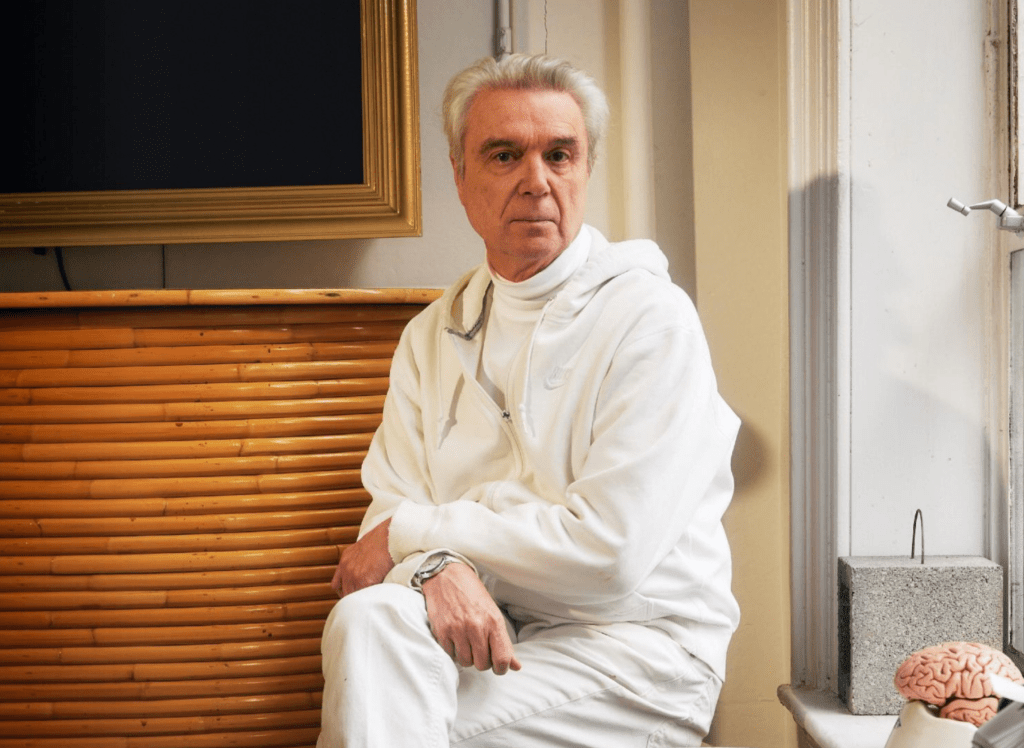
Is David Byrne okay? Over half a century, the musician, artist, writer and filmmaker has established himself as one of modern America’s leading cultural forces – ‘rock’s renaissance man’, as Time magazine once hailed him. But in recent years, the former Talking Heads frontman has started to ask himself: Does any of it really matter?
“When you see what’s going on in the world, you do feel like, ‘what can I say?’” admits the 73-year-old, talking to Weekend over video call from his New York office. “I certainly felt that way during the pandemic. Watching eight ambulances lined up on the corner of my street, I thought ‘maybe writing my quirky, kinda uplifting songs isn’t really cutting it’. And with the news cycle like it is at the moment, and everything going on, you do think: ‘Is anything I’m doing having any effect?’
“But I think it does,” he’s concluded. “When people come up to me to tell me something I’ve done has meant something to them, I think: ‘Okay, maybe I’ll soldier on’.”
Well that’s a relief. It would be terrible if he’d decided it was all for nothing. “That’s right, it’s all meaningless!” he laughs. “I’m going to erase it all!”
Proof of his renewed faith arrives this month in the form of Who is the Sky?, Byrne’s first new album in seven years. Recorded with a starry guest cast, including avant-garde ensemble Ghost Train Orchestra, Paramore’s Hayley Williams and longtime collaborator St Vincent, it certainly doesn’t sound like the work of a man who’s lost his mojo.
How would he describe it? “Well, my first thought is that’s your job,” he smiles. “My job is to make it, your job is to describe it.”
Fair enough. In which case I’d say it’s building, in part at least, on the themes of his previous album, American Utopia – later turned into a hit Broadway show and a Spike Lee film – and his Reasons To be Cheerful online ‘good news’ magazine, by trying to shine a line in dark times.
“Yeah, there’s definitely some of that,” he nods. “Though sometimes I think that feeling comes across as much through the music as the lyrics. Sometimes the lyrics are a little contradictory, or questioning, but the music buoys them up with a kind of energy. There’s a playfulness to it.
“In some departments, it’s hard not to feel like the dark is winning,” he concedes. “But I’m not ready to throw up my hands yet. I’m an optimist by nature. I’m not sure how that happened. Maybe it’s just years of making music. It’s a pretty nice job to have.”
He does feel as if he’s being “tested”, he says. “But I find bits of hope and positivity where I can.” Hence recent single Everybody Laughs, which he describes as “a kind of love letter to human beings, with all their faults and foibles”, set to a jaunty Latin groove. Often, he adds, the things that bring him hope are “very local”. (As we speak, Reasons to be Cheerful – which promises ‘a weekly dose of dopamine to your inbox’ – is running stories about everything from the resurgence of Atlantic mackerel stocks to an urban planting scheme in Rotterdam.)
“Is that Robert Smith behind you?” he asks, becoming distracted by a picture on my wall of the Cure frontman looking characteristically glum beneath the words ‘live, laugh, love’. The joke appears to really tickle him. “Another optimist,” he says. “He was picked by Olivia the other day as well,” he notes, speaking shortly after Smith’s guest appearance during Olivia Rodrigo’s Glastonbury headline set. A couple of weeks earlier, Byrne himself had joined the pop superstar on stage for a duet of Talking Heads classic Burning Down the House. “She was very generous. I said, ‘let’s do some dancing, let’s work out some moves’ and she was totally game. She was great.”
For Who is The Sky?, Byrne has joined forces with British superproducer Thomas Hull, aka Kid Harpoon, the man behind the biggest-selling singles in the world in 2022 (Harry Styles’ As It Was) and 2023 (Miley Cyrus’ Flowers). No pressure, then… “No pressure at all!” he chuckles. “I reached out to him and said, ‘I realise my songs are maybe a little different to the ones you’ve been doing in the last few years’. I like to think they’re accessible, but they’re kind of atypical. But he really enjoyed the demos, and immediately said, ‘let’s try to figure this out…’”
The result feels very much like a classic David Byrne record, from the infectious rhythms to the idiosyncratic subject matter, including a love song dedicated to his apartment, and the whimsical tale of a moisturiser that’s so powerful, he ends up looking like a baby. (“The thing about David is that he’s in on the joke,” says Harpoon. “He gets the absurdity of it.”)
If there is any lingering sense of an existential crisis, then it’s probably to be found on The Avant Garde, a twitchy jazz-pop number in which our hero questions whether the sort of experimental art he’s dedicated his life to is actually any good.
“I’ve fairly often been lumped in with that crowd, for better or worse,” he reflects. “Which doesn’t bother me at all. I love a lot of the exploratory work that goes on outside of the mainstream. But as the song says, it can also be a load of crap, that leaves you wondering, ‘how did they get away with this?’ I’ve realised it’s about risk: are you willing to spend an evening trying to understand something, in the hope you might find a diamond that will change the way you look at the world? It’s a bit of a lottery.”
He’s unearthed a few diamonds himself over the years, I suggest. “Once in a while, yeah,” he smiles – somewhat modestly for a man who’s won a Grammy, an Oscar, a Golden Globe and a Tony, and been inducted into the Rock and Roll Hall of Fame.
In truth, Byrne has always been as much a performance artist as a traditional rock frontman. Talking Heads, which he formed with fellow Rhode Island School of Design students Chris Frantz (drums) and Tina Weymouth (bass), plus guitarist/keyboardist Jerry Harrison, may have emerged from New York’s 70s punk scene (their first gig was opening for the Ramones), but they quickly outgrew the movement, combining a restless blend of new wave garage rock, funk, Afrobeat and Latin rhythms with a distinctive visual style.
“I felt like a lot of wonderful stuff had already been done – the usual kind of postures and poses and blues-based rock, all that stuff,” he explains. “I just thought, ‘well it was fun growing up with all that, but I can’t do that. I have to come up with a new thing that means something to me, and the people around me.’”
It ended up meaning something to quite a lot of other people, too: Talking Heads went on to sell millions of records, including such iconic hits as Psycho Killer, Once in a Lifetime, Burning Down the House and Road to Nowhere, before calling it a day in 1988. Since then, Byrne has combined making solo records with scoring movies, writing operas, running a world music label and launching an online radio station. He’s also given TED Talks, designed cycle racks, played himself on The Simpsons (twice) and once turned a defunct ferry terminal into a giant musical instrument. Liam Gallagher he ain’t.
Despite his many successes, he still likes to think of himself an outsider – a sentiment expressed with unusual directness on the new album in a song called… well, I’m An Outsider. “Other people say, ‘okay, David, you’re thoroughly inside now, you can’t pretend you’re not part of the establishment’. But I still feel like I’m not quite there yet. There are still times when I try to go somewhere and they go ‘no, sir, you’re not allowed to be here’.”
I wonder if his sense of otherness comes in part from being an immigrant: born in Dumbarton, Scotland, he was still a toddler when the family emigrated to Canada, and eight when they settled in Arbutus, Maryland, where his engineer father got a job with the Westinghouse Electric Corporation.
“That’s a part of it,” he nods. “I think part of it is my nature but yes, being in an immigrant situation, where you realise you and your parents are different from the other kids and parents around you, makes you start to wonder about a lot of things. ‘Why do Americans eat the way they do?’ Immediately, you’re questioning a lot of things, rather than just accepting them wholesale.”
Has he gone native over time? “I can fit in pretty well, I think,” he says. (In 2012, he finally acquired American citizenship, but also holds British and Irish passports; the latter, he tells me, is his emergency ‘bolthole’ if Trump’s America gets too much.)
Since Talking Heads split up, there has been little love lost between Byrne and his former bandmates, with Chris Frantz and Tina Weymouth criticising their former frontman for his alleged dictatorial behaviour. But in 2023, all four members appeared together at the Toronto Film Festival to promote a new 4K restoration of their widely acclaimed 1984 concert film Stop Making Sense (the one in which Byrne sports the iconic, comically oversized suit). And then, earlier this year, their record company began issuing cryptic announcements on social media, alluding to an announcement on 5 June – the 50th anniversary of their debut concert.
Hopes of a reunion tour, though, were crushed when it turned out to be just a new video for their seminal 1977 song Psycho Killer. Sure, it’s a rather stylish video, starring Hollywood A-lister Saoirse Ronan, no less. But might, in retrospect, it have been handled differently, without leaving fans feeling gaslit? “There probably would have been a way to do that,” Byrne acknowledges. “But I imagine the record company secretly liked the idea they might be teasing something. They get more attention that way.”
So, for the tape, the position hasn’t changed: despite a reputed offer of 80 million dollars, Talking Heads will not be reforming? “No, it has not changed,” he says. “You can’t wind back and be the person you were all those years ago. But we get along. We’re all talking.”
Does he understand why fans – perhaps naively – get upset by the idea of their favourite bands at each other’s throats? “Yeah,” he nods. “These people who’ve written music that might move or touch you, that you have a personal investment in… You’d like to think they’re the same good people who show up in their songs. And sometimes you start to see, ‘oh god, this person is actually a nasty piece of work’. And that starts to reflect on the songs.”
It’s obviously annoying to have spent so many years fending off questions about a Talking Heads reunion. But I put it to Byrne that people not caring about it would surely be worse? “Yeah, absolutely,” he concedes. “That’d be really sad.
“Hey, look at this cup I got handed,” he says, apropos of nothing, holding up a mug with a picture of former Canadian prime minister Justin Trudeau riding a unicorn, in what may or may not be an attempt to deflect from the subject of a Talking Heads reunion.
He’s a man who’s clearly happy in his own company, talking contentedly of time alone in the “weird womb” of his apartment, cooking, drawing, playing music and watching old movies. But in early September, he announced his surprise marriage to 55-year-old hedge fund manager Mala Gaonkar, more than 20 years after his divorce from costume designer Adelle Lutz, with whom he has a daughter, Malu, and a seven-year-old grandson.
Though he’s never had an official diagnosis, Byrne thinks he’s probably “on the very mild end” of the autism spectrum. “I can be uncomfortable in social situations,” he says. But it also has its upside: “The ability, or tendency, to focus intently on something, at the exclusion of everything else, is something that can be very useful at times,” he admits. “And very annoying to people at other times.”
As we wrap up, I tell him again how glad I am he’s decided it hasn’t all been in vain. Because it’s been quite an extraordinary life, all things considered. “Yeah,” he says, as if weighing the idea up. “So I hear.”
Who is the Sky? is out now on Matador Records. David’s UK tour kicks off at Cardiff Arena on 2 March
An edited version of this interview was published in Waitrose Weekend on 25 September, 2025
 Interesting Media