The past decade has not been kind to the great sci-fi and fantasy properties. Star Wars, Star Trek, DC and Marvel have all tarnished their legacies by prioritising quantity over quality, and even Doctor Who is currently lost in the time vortex. Meanwhile, a young pretender has stepped in and seized the throne with a simple, old-fashioned formula of telling strong, compelling stories with heart, humour and characters we actually care about.
Launched with minimal fanfare in 2016, Stranger Things quickly grew into a word-of-mouth phenomenon, becoming one of Netflix’s biggest hits – the fourth season currently stands as the streamer’s third most-watched English language show of all-time (behind Wednesday and Adolescence) – and winning more than 80 major awards, including 12 Primetime Emmys.
A tale of eerie goings-on in 80s small town America, where scientists are cooking up something nasty in the backwoods of Hawkins, Indiana, Stranger Things – which returns for its fifth and final season next month – took inspiration from a grab-bag of late 20th century sci-fi and horror, from Twin Peaks and The X-Files to the works of Stephen King and John Carpenter. Above all else, though, the show – created by identical twins Matt and Ross Duffer – is a love letter to the child-centric yearning of early Steven Spielberg, starring a bunch of bike-riding, walkie talking-sporting kids straight out of E.T. and The Goonies.
In doing so, it harks back to an age when stories and characters were more important than empty CG spectacle; an age when scripts were locked before the cameras started rolling – instead of being stitched together in the edit, as has become standard Hollywood practice – and audiences demanded a more satisfying resolution than someone knocking lumps out of the New York skyline for the hundredth time this year.
It’s also a show with a huge heart. Sure, Stranger Things is scary: the Upside Down, the shadow realm into which young Will Byers was dragged in the first season, is the stuff of genuine nightmares, while creatures like the Demogorgons and the Mind Flayer make Darth Vader look positively cuddly. But, in the best Spielberg tradition, it’s also a feelgood show that unashamedly champions the virtues of friendship, loyalty and bravery.
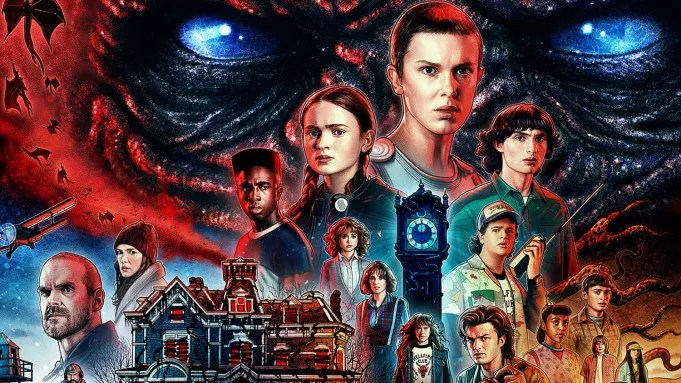
The series made instant stars of its brilliant young cast – seventh graders Will (Noah Schnapp), Mike (Finn Wolfhard), Lucas (Caleb McLaughlin) and Dustin (Gaten Matarazzo), their teenage older siblings Jonathan (Charlie Heaton) and Nancy (Natalie Dyer), Nancy’s boyfriend Steve (Joe Keery) and Eleven (Millie Bobby Brown), a psychokinetically gifted girl who becomes part of the gang after escaping from the Hawkins lab. All are well-drawn, likeable characters, who in subsequent seasons have been joined by new fan favourites including Max (Sadie Sink), Bob (Sean Astin – an actual Goonie), Robin (Maya Hawke) and Eddie (Joseph Quinn).
It’s the relationships – both romantic and platonic – between these characters that are the beating heart of the series. Early on, you’ll cheer as Nancy dumps alpha-jock Steve for troubled geek Jonathan – but then Steve himself will go on a journey, his friendships with goofy Dustin and Maya, his lesbian co-worker from the Scoops Ahoy ice-cream parlour, becoming a highlight of the show. You’ll root, too, for star cross’d young lovers Mike and Eleven, and for the late-blooming romance between Will and Jonathan’s mum Joyce (a career-reviving role for Winona Ryder) and police chief Hopper (David Harbour).
In a television drama landscape dominated by grim, noir-ish thrillers, Stranger Things is also not afraid to be laugh-out loud funny. Who can forget Dustin and girlfriend Suzie’s duet to The Never Ending Story?, Steve sheepishly admitting he uses Farrah Fawcett hairspray, or every scene-stealing appearance by Lucas’ sassy kid sister Erica (“you can’t spell America without Erica”)?
It’s a measure of how central quality writing is to the show that a spin-off play, Stranger Things: The First Shadow– written by Kate Trefry from a story by the Duffer Brothers and Jack Thorne, no less – has also proved a West End and Broadway sensation, winning two Olivier and three Tony Awards. (Can you imagine an Olivier Award-winning Star Wars play? Anyone?)
It’s not perfect, of course. Season Three – with its ridiculous final stand-off in the mall, where the Mind Flayer was sent packing using fireworks and balloons – seemed in danger of jumping the shark. But the show recovered its mojo in the fourth season, in which Max was kidnapped by the terrifying Vecna (sending Kate Bush’s Running up That Hill to the top of the charts in the process).
So all the Duffer Brothers need to do now is stick the landing with the final run, and the show’s legacy as an all-time TV classic will be assured. (Cracking theme tune, too.)
Stranger Things Season Five is on Netflix from 26 November; Stranger Things: The First Shadow is at the Phoenix Theatre, London
This article was published in Waitrose Weekend on 23 October, 2025
 Interesting Media