Now that he’s a knight of the realm, Sir Grayson Perry has given up any pretence of not being part of the establishment. “One of the things that absolutely infuriates me is millionaire cultural celebrities pretending they’re outsider rebels,” says the Turner Prize-winning artist, writer, broadcaster and career provocateur. “I’ve often described myself as being inside the tent, pissing in. And with the knighthood, and the CBE before that, there was definitely a bit of me that thought, ‘oh, this will wind people up’.”
It’s a typically impish bit of mischief-making from a man who takes an obvious delight in subverting expectations – particularly from those on his own side. As a working-class Essex boy who’s been embraced by the art establishment, he’s refreshingly honest about its affectations – “I’ve made so much money out of the snobbery of the art world”, he says, beaming – and he’s equally keen to challenge the people who turn out to see his live touring shows.
“I know my audience: they’re left-leaning, educated, middle-class, nice people – and I make them suffer for that,” he says, with a wicked cackle. “A lot of culture has formed a bubble around an agreed set of progressive shibboleths, and many people seem completely unaware that the orthodoxies that have accreted around their opinions aren’t perhaps universally held.”
His latest theatre show, Are You Good?, is an attempt to explore “whether we’re as virtuous as we think we are”. A mix of conversation, audience interaction and silly songs, Perry says it’s designed to be a fun night out – albeit one which promises to leave the audience’s “core values completely in tatters”.
So why this question, and why now? “I’m fascinated by the way online culture is changing the modern world,” he explains. “We used to have religion to give us clear instructions about what’s meant to be good – The Ten Commandments, etc. And we still have a need for quite strict codes of morality and conduct, but they’re enforced in different ways now. If you look at social media, it’s a lot of people either judging who’s good or bad, or telling people off for being bad, or bragging about how good they are. It’s like there’s a collective voice which hovers in the back of our minds, a bit like God.
“When we think about that voice, it probably used to be a kind of patrician, right-of-centre voice, telling us how we should behave,” he suggests. “Now, it’s a little more shrill, and probably quite left-wing. And all the nuance has been bled out of it. There’s no context or tonal register on social media, so now it’s become, ‘if you say a certain word, you are bad’.”
The title of the show begs the obvious question: is Grayson Perry good? “Me? No, I’m as flawed, and I make as many mistakes, as any other person,” he smiles. “And that’s fine. I’ll do. I’m good enough.”
What are his biggest flaws? “Well, obviously I’m a deep dark pervert,” he laughs, parroting the reaction he occasionally encounters as Britain’s most famous transvestite. “Sometimes I get people coming up to me on the street saying, ‘are you a paedophile?’ Because I’m wearing a dress, or whatever. And I always say – in my head, anyway – ‘actually, they tend to look more like you, mate’.”
Perry has made a career out of getting under the skin of social norms and human behaviour – through his art, but also through acclaimed TV documentaries on subjects including masculinity, class and taste. His Bafta-winning 2014 series on identity, Who Are You?, was particularly well timed to meet the age of ID politics. “I remember saying to my director, around about 2012, ‘this word identity keeps coming up in conversation more and more,’” he recalls. “And I’m sort of puzzled about what it is.”
Is it a good thing, does he think, that we’ve become better at interrogating who we are? Or is there a danger our introspection has now tipped over into narcissism? “It’s sort of fundamental to a lot of things,” he considers. “But I think we might have peached peak identity politics now. I think it will settle back. The pendulum swings, and there are readjustments in the culture, and we find a working solution.”
“I’m fortunate, in that by the time gender became politicised, I was already ‘that lovely Grayson Perry'”
I ask how the culture wars raging around gender identity, in particular, have impacted his ability to be seen as his female alter-ego, Claire. “It’s made it more politicised,” he says. “And maybe I’m a bit more self-conscious. But I’m fortunate, in that by the time it became politicised, I was already ‘that lovely Grayson Perry’.”
He’s been ‘that lovely Grayson Perry’ for more than two decades now, though his national treasure status was perhaps only fully cemented during lockdown, when his Grayson’s Art Club TV show got the whole country drawing. Two decades earlier, he’d come to widespread attention when he won the 2003 Turner Prize for his ‘troublingly beautiful’ ceramics, which saw him daubing classical, Greek-style vases with vivid depictions of dark, disturbing and sometimes autobiographical subject matter.
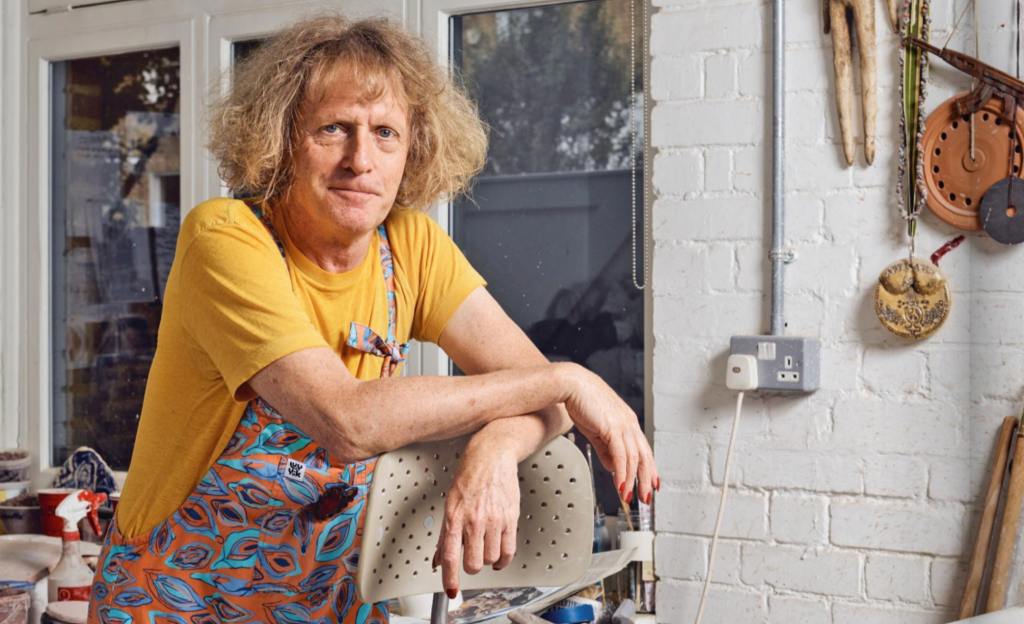
Accepting the award dressed as Claire – described in the press at the time as looking ‘like a cross between Shirley Temple and Little Bo Beep’ – he said: “There aren’t many other worlds that would be so accepting of a transvestite potter from Essex.” (Today, talking over video from his studio in Islington, north London, his only bold fashion choice is a bright yellow t-shirt.)
In the years since his breakthrough, Perry’s art has combined ceramics with tapestries, prints, cast-iron sculptures, dresses and even a complete house, built by the River Stour in Essex (and now available to rent for weekends). His latest exhibition, on display at The Wallace Collection in London until October, goes under the very Grayson Perry title Delusions of Grandeur. “Obviously, I have delusions of grandeur,” he explains, of new works that include everything from carpets to armour. “For this show, I invented an artist with a mental health condition who imagined she was the rightful heir to the Wallace Collection, and I used that as a sort of vehicle to make the work I wanted to make. I had a lot of fun with it, and it seems to be a success.”
Of equal cultural significance – to him, at least – was his recent appearance on ITV’s The Masked Singer, showcasing an impressive set of pipes belting out songs like Luck Be A Lady while dressed as a giant kingfisher. It’s not the sort of place you’d normally expect to find a member of the Royal Academy of Arts, but then this is an artist who’s spent much of his life kicking down the barriers between ‘high’ and ‘low’ culture. “That phrase ‘guilty pleasure’ is always kind of a tell, isn’t it?” he says. “Why are you guilty about them?”
Previously, Perry has described growing up in an ‘acultural’ household. “I mean, obviously nowhere is acultural – it’s kind of a snobbish thing to have said, really,” he suggests now. “Everybody has culture – ours just happened to be different from the kind of accepted, middle-class definition of culture you get in the review pages of the Sunday broadsheets. At home, the telly was always on, and we had The Sun and the Daily Mirror, and the radio.”
It wasn’t a happy childhood. His parents divorced when he was four, following his mother’s affair with an actual milkman, after which he spent time shuttling between homes. “My mother was volatile, and so was my stepfather,” he recalls. “She would explode, and then call in the fighter bomber that was my stepfather.”
At school, he found sanctuary in the art room, and has spent a lifetime pouring his formative experiences into his work (his childhood teddy, Alan Measles, is a recurring presence). But there’s also a physical legacy: his wife, the psychotherapist, author and broadcaster Philippa Perry – with whom he has a grown-up daughter, Flo – introduced him to “the guru of body therapy”, who taught him that “emotions are our brain’s attempt to interpret feelings coming out of our bodies. Our bodies hold the memory. They know more than us about a lot of things, like our childhoods. And so I suppose I’ve got this sort of working-class, dysfunctional family body, that I’ve kind of made work for me, in a really good way. It helps with things like performing. And I think a lot of my thinking comes from the mischievous, giving zero fucks attitude of my mother.”
As a young man, living in London squats while trying to establish himself as an artist, he also inherited his mother’s short fuse, but six years of therapy helped make him a calmer person. “I hardly ever lose my temper now, whereas before it would be a daily occurrence,” he says.
Therapy also helped him adjust to becoming a public figure. “I was lucky – I was having therapy just when I sort of popped my head over the parapet,” he says. “It’s a big thing, for an artist to suddenly realise they have an audience, and a market value. It can make you self-conscious, and a bit inhibited.
“I remember the day I started my art foundation course [at Braintree College of Further Education]. I suddenly had this realisation that, ‘oh, this is full time now. This is my chosen career.’ And when something goes from being a hobby to a job, it’s a very different thing. Suddenly, you’re defining yourself as an artist, and relying on it for your income. And then when you become successful, you have to get used to being successful. A lot of people really struggle with that – you see it happen with young pop stars. But I’ve been lucky. I’ve had a very gradual rise. I have a blessed life.”
Does he think the money some people are prepared to pay for his art is obscene? “No,” he shrugs. “If people want to spend that amount of money on something… It’s worth what it is. And it’s not a zero-sum game – a lot of people who collect art also spend money on good causes.”
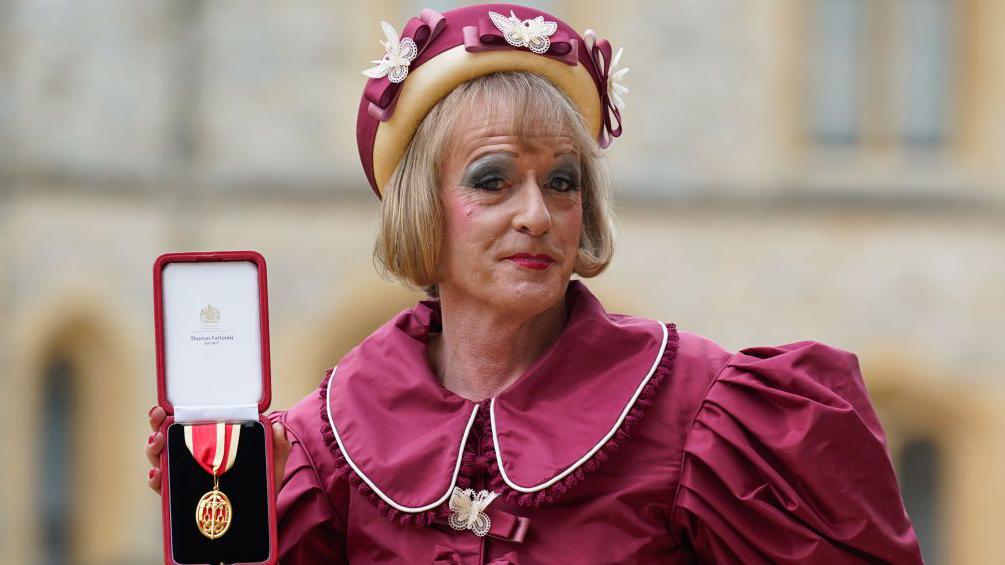
When the offer of a CBE came in 2013, he idly considered turning it down, until his daughter told him not to be so “affected”. And it was her words he had ringing in his ears when, a decade later, he was knighted at Windsor Castle by Prince William, while wearing a burgundy taffeta frock. Is he the first person to be made a Sir while wearing taffeta, as far as he knows? “Well, maybe for a while,” he says. “I’m sure Francis Drake had a set of taffetas.”
A self-styled ‘Christian atheist’, Perry has long been fascinated by religion. “I love religious art, culture and architecture,” he says. “But I struggle with the belief thing. I think religion was invented because we know we’re going to die. But for me, when we die is just like before we were born. I don’t want to die, but I won’t be around to worry about it.
“I’m really interested in AI at the moment,” he adds. “I use AI quite a lot in the new show, as a kind of sidekick. And the one thing AI is really good at showing us is how to be human – because it fails miserably at it. It doesn’t have a body, or feelings, it can’t bleed, and it doesn’t know it’s going to die, which is fundamental to the way we operate.”
Now 65, Perry has long since concluded there’s nothing as trite as a ‘meaning of life’ – which is fine by him, because it’s our job to try to impose meaning. “And art is a good way of doing that,” he says. “But it’s not the only way. A really good plumber can also make life meaningful.”
Grayson Perry: Are You Good? tours the UK from 7 Oct-7 Dec

